
Author: Grace
We asked: Does the future of aerospace include advertising?
 Advertising — once the mainstay of BDN’s business — is now a source of ongoing discussion, debate and uncertainty within the Aerospace and Defense industry. Our team routinely fields a great many advertising-related questions from clients and colleagues. We find that in general, people want to know if advertising is relevant, effective and worth the investment — and they often want to know about industry trends and understand what their peers are or are not doing.
This survey, “The Role of Advertising in Aerospace and Defense Marketing,” was designed to get a sense of trends and how advertising is used and viewed in our industry today. Based on more than 150 responses, from marketers covering a broad array of industry segments, it is not a scientific but is certainly suggestive. We hope you find it useful.
Key Finding: Advertising is in decline, and people who once advertised are no longer advertising.
While 93% of respondents said they have advertised in the past, just 72% say they advertise now.

Key Finding: In general, the majority of advertising budgets are increasing or staying the same. Fewer budgets are declining.
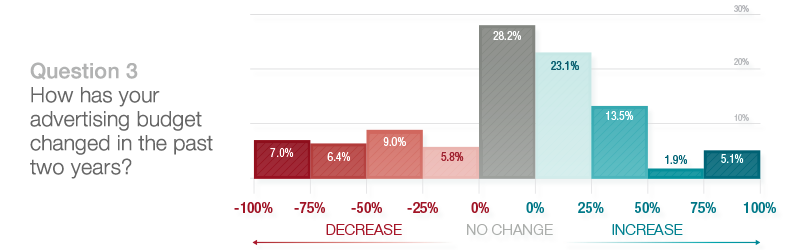
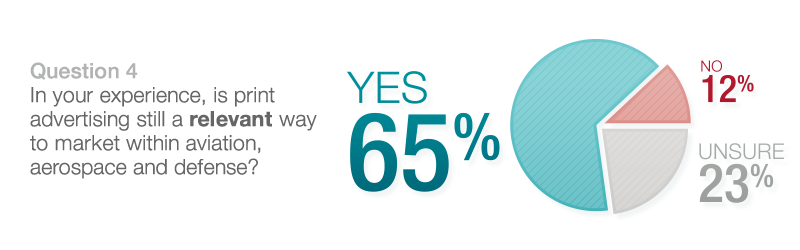
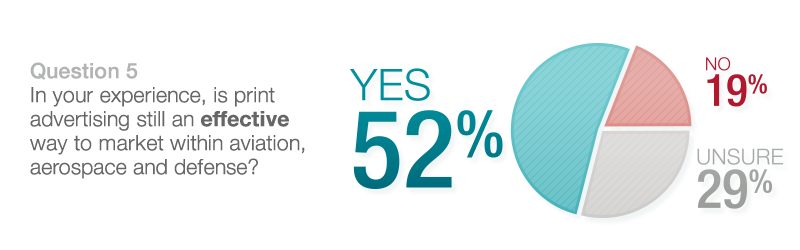
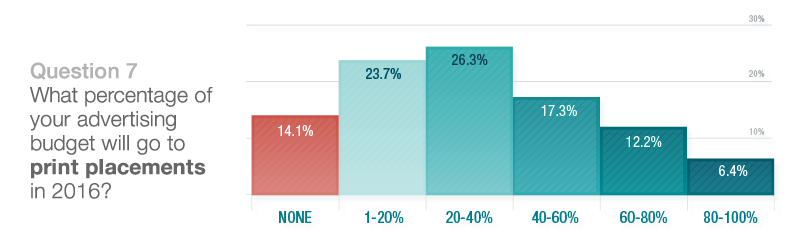
Key Finding: The majority of respondents think print advertising is still relevant and effective in our industry, but many are unsure.
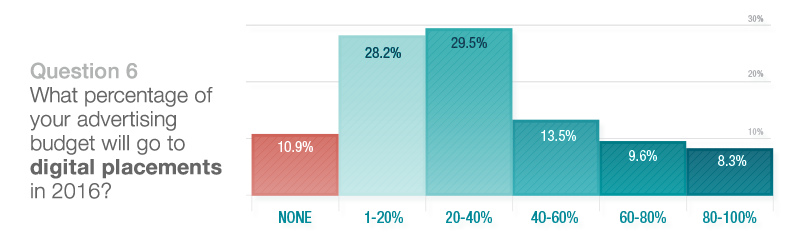
Key Finding: While print is still important to respondents, digital is growing in importance, with spending split fairly equally between print and digital.
Next Up: Our series on the “The Role of Advertising in Aerospace and Defense Marketing,” will continue next week as we reveal industry marketers’ preferred publications. Watch for the People’s Choice results on April 12.
Don’t Forget: BDN’s Complete Guide to Aerospace & Defense Media is a great resource for industry advertisers. Download it here.
Effective Strategies for Print & Online Aviation Marketing
Writing for BDN, Jill Fontaine recently interviewed Carol Dodds, Vice President of Advertising and Partnership at Aircraft Owners and Pilots Association (AOPA ), to discuss a variety of issues that impact aviation industry marketers. Carol provides key aviation and aerospace brands a selection of print and digital advertising opportunities and for over 9 years has successfully connected advertisers and marketing professionals with their target audience of general aviation pilots, aircraft owners, and aviation enthusiasts.
Jill: AOPA represents many influential brands in the industry. Can you give a few examples of brands that are creating innovative print campaigns?
Carol: Bose, Garmin and Icon are among those that I always suggest people reference for great ad content. We are also seeing smaller companies create very engaging content in their ads. Genesys Aerosystems always impresses me with their smart print ads that they couple with blogging and online content on topics that people are genuinely interested in learning about. They do a really good job educating their potential customers about a product that, at times, can be difficult to understand.
Other companies, like Blackhawk Modifications, are getting very creative with their print ads, while saving money and maintaining high visibility. They are getting dominance across a 2-page spread without buying the 2-page spread. It’s actually pretty clever! On the right-hand side, they’re buying a full-page ad and doing a great bold image with a short headline. On the left-hand side of the spread, they’re buying a 1/3-page vertical ad and tying them together with color and branding, this is a perfectly functional “2-page” ad. And honestly, that leaves us with only editorial that can be placed on the page with their 1/3 ad. So really, they’re getting ad placement right in the middle of an article. You couldn’t ask for better visibility.
Jill: What a trick! Is this something you’re sure you want to be sharing?
Carol: Of course. I think it’s really clever marketing. I always want our advertisers to get the best “bang for their buck” and this is a great way to do it. I also think it shows just how versatile print advertising can be. You have to make it work for you and the budget you have. You don’t have to buy a 2-page spread to get good visibility. I work hard for my advertisers, and my main goal is to get their message out there, no matter their budget.
Jill: What marketing trends are you seeing in aviation print advertising right now?
Carol: I’m seeing that the most successful and eye-grabbing ads are those with bold images, incredible beauty shots, or very tight detailed shots of a product. A lot of advertisers are coupling these bold images with dramatic one-word or one-phrase headlines to keep it simple and clean while still getting the reader’s attention. This style is very effective, but is hard for some, more traditionally rooted, companies to accept.
I’ve also been very intrigued with the advertorial direction that some ads are going. With this style, we see brands using smaller images and focusing on telling their reader a story.
Native advertising or “editorial-like” ads often feature a customer’s testimonial or content that educates the customer about the brand. You have to have amazing copy in order to pull this off though. You want the copy to feel like part of the magazine’s content, not an overt promotion. That’s the trick. Give the reader the opportunity to learn something of value instead of being sold something.
Jill: Do you think one ad style is more effective than the other one?
Carol: No. It’s trial and error, really. Advertisers have to see what works for their brand and their customers. Some of the best ads I’ve seen have been combinations of both styles. They’ve successfully incorporated a beautifully branded image with the right amount of editorial content. The combination of the two often provides marketers more comfort because they don’t have to go buck wild in one direction or another.
Jill: Has the 24/7 accessibility to a brands message via the Internet and social media affected the way that AOPA readers and advertisers view print advertising?
Carol: Yes, I think it has. People can access information about your brand any time they want to, so picking up a magazine is now only one of many ways they can learn about your product. This is one of the challenges that aviation marketers today have to overcome. We’re an industry that is very comfortable in print advertising and sometimes it’s hard to educate brands on the true need for online, social and video marketing. Good marketers use a hybrid of print and digital to engage on more levels with their customers. Advertisers should be using print for serious branding and story telling, then driving the customer to an online page where they can take action on the information they just received from your print ad.
Jill: Is online advertising effective on its own?
Carol: I’m a firm believer that online advertising is most effective when it’s backed up by a branded print advertisement that tells the story of a product. I don’t know any successful brands that have focused their marketing strategy solely on print or solely on digital marketing. Both serve different purposes and different parts of the sale cycle. Advertisers should be using print to drive traffic to their website. This is why print is still relevant. If a customer is reading a magazine, they’re most likely relaxed and have some time on their hands. If that same customer is online, there is a much shorter attention span and a much smaller window to deliver your message. It’s important to understand that people are distracted online and now have an expectation about online advertising. Advertisers can use their print campaigns to deliver a bold idea and drive them to do further product research or take an action on your website or landing page.
Jill: How can marketers successfully integrate a digital marketing strategy into their existing print strategy? Will it require additional budget?
Carol: It’s not expensive or difficult to carry over a branded look and feel online. It’s about providing customers with brand consistency. They see your brand in print, they should also see it online. Think of the print ad as brand education and the online ad as your call to action. Online ads encourage your customer to pick up the phone, click on the contact info, find a sales rep, or even make a purchase. There’s a sense of urgency in online advertising, and that’s the key. Most of the print advertising opportunities these days comes with an option for online advertising as well. At AOPA we always encourage our advertisers to do both, and we also offer them a large range of different platforms and different price points to choose from. It comes down to distributing your budget across online and print. For a campaign to be successful, you shouldn’t have your entire advertising budget in one area.
Jill: We’re talking about creating a funnel of sales leads here, starting with print and ending with an online call-to-action. How important is a company’s website in this process?
Carol: If there is one place where a marketing strategy loses its steam, it’s the website! As marketers, we spend so much money on print ads and online visibility, but when a customer finally shows up at the website ready to buy, they often fall into an abyss of unorganized or unrelated information. We essentially throw them into a dark room and cross our fingers that they can figure out how to buy our product. Ineffective websites don’t happen by permission though, they happen by omission. Make sure to lead your customers to exactly where you want them to land on your site and keep it up to date and engaging. Print and online ads won’t convert to sales unless your website is ready to handle the traffic that is being directed to it.
Jill: Where does email marketing fall in to all of this? Seems like it should be as important as the website in converting leads to sales.
Carol: Definitely. Email marketing is not a thing of the past; it is still a critical part of any effective marketing strategy. At AOPA, we find it effective to add marketing content to emails that our members are already expecting from us. It may be a renewal notice or an account reminder, but we include some effective marketing content that reminds our member to take advantage of another benefit we offer. People get so many emails. The more you can combine your messages into one email, the more likely you are to reach your customer.
Jill: Let’s talk a little bit about the sales team’s involvement in this process. Is it important for marketers to get buy-in from their sales team to develop these ads for print and online?
Carol: Yes. It is so important for marketing professionals to educate their sales counterparts on the importance of innovative marketing. Here at AOPA, we do our own media marketing and it’s very much a team effort with our sales force. We involve the sales team in the front end of the process when we’re developing the message, the images and the execution. When you involve the sales team early on, you ensure that the customer transition between marketing and sales is efficient. We want everything to be easy and seamless for the customer. You don’t want it to feel like a cold call when the sales team talks to the customer. The lead generation work that marketing efforts produce is very important, and the sales team wants to be involved and informed. They need quality information so they can successfully close the sale. We ask our sales team for copywriting input to ensure our ads have the right “voice”. Sales people understand the language that our customers speak. That comes in very handy for writing effective marketing material.
Jill: I’m glad you brought up understanding the customer. In addition to insight from your sales team, do you see value in engaging with customers in online forums and social media platforms?
Carol: Yes, I see value in online engagement. But I think it’s a very particular type of conversation. We use it to put ideas out there and to get a better understanding of our customers wants and needs as AOPA members. Online forums and social media sites aren’t the places for us to be “selling” our members a specific product. Forums are meant to be a place for open opinions, not blatant promotion. So yes, I think it’s an important way to gather customer insights, but it’s not a place for a sales pitch. We see social media as more of a customer service function rather than a direct marketing function.
Jill: Do you have any other advice for our readers who are looking to improve their print and online marketing strategy?
Carol: Be thoughtful and precise about your message. Be clear in how you write and what you say. Remember that people won’t give you more than a few seconds of their time for you to sell them something. They will, however, enjoy and appreciate a message that offers them new information or something of value. The offer and message you select and how you select them determine the success of your marketing campaign.
To improve your advertising even more, make sure you have a compelling value proposition. Here’s a useful guide with examples, a checklist, and more.
A Legacy of Leadership
 Our third interview in this month’s leadership series should have been with our long-time friend Jeff Pino. Working with Jeff over the years, we were afforded a front row seat to a master class in marketing, in leadership, and in life, and we couldn’t wait to share some of that with you, too. Instead, we find ourselves writing about Jeff’s legacy.
In keeping with his wishes, the Jeff Pino Foundation has been established to create the future leaders of aviation and aerospace, a new generation we urgently need to move us forward.
The goal of the foundation is to create and help fund programs that will support young people who aspire to have careers in the aviation, aerospace and Science, Technology, Engineering and Math (STEM) disciplines.
The foundation will take this a step further by partnering with industry professionals to provide practical experience so students can apply their knowledge to real-world problems.
We know Jeff’s contributions are worth remembering, and his legacy is worth supporting. But you didn’t have to know Jeff to understand why it’s so important to nurture and develop our next generation of inspirational leaders.
You can help with a financial donation or simply by providing work opportunities for students. For more information visit www.pinolegacy.com or email donations@pinolegacy.com
Leadership Q&A: Lee Benson, CEO of Able Aerospace Services
 Lee Benson is CEO of Able Aerospace Services, a leading MRO provider of FAA approved replacement parts, repairs, overhauls and exchanges. He started his career as the first employee in a small company offering specialty electroplating services to repair aircraft components. In 1993, after the company lost virtually all of its business overnight, Lee purchased the entity and immediately deployed a vision to rebuild. He went on to found Able Engineering and Component Services in 1995 and Able Aerospace in 1999. In 2016, Able was acquired by Textron Aviation, Inc., a Textron, Inc. company, a global general aviation authority that includes 21 company-owned facilities dedicated to complete aircraft life-cycle support.
In January 2016, Lee spoke with BDN’s Kyle Davis to discuss a variety of issues that impact aerospace industry marketers.
BDN: The aircraft MRO market is crowded and highly competitive. How has Able been able to stand out, succeed and grow?
Lee: By having a relentless focus on being the best value alternative for our customers. Harmonizing all macro organizational functional groups around this goal is where the real magic happens.
BDN: Our Flight Manual readers are marketing professionals involved in aviation, aerospace and defense. With that in mind, how important has marketing been to your business success, and what is your strategic and tactical approach to marketing your products and services?
Lee: At Able we look at business generation holistically. Marketing’s job is to support all of the functional groups within Business Generation to better make profitable sales in a way that is always a win-win for our customers and Able. In our company, Marketing owns TAM (total addressable market), sales tool kits, brand, common approach to value proposition communication, email campaigns, websites, etc. Doing marketing right is extremely important!
BDN: Able has recently been purchased by Textron. In your estimation, did the strength of the Able brand play a role in Textron’s interest in the acquisition? Can you elaborate on that for our readers?
Lee: Part of Able’s vision is to be recognized as the industry leader for the services we provide. To do that we have to perform when it comes to customer experience (quality, delivery, communication, etc.) and total value delivered to each customer. We believe Able has fully earned this reputation based on the work we do and our brand has to match it. We have worked very hard on our brand guide over the years to this end. Our brand has to reflect the amazing experience customers have when working with us. I’m sure this helped with how Textron viewed Able prior to the acquisition.
BDN: What advice can you offer to people who are marketing and selling their products and services to businesses like Able? What is the secret to reaching and connecting with you in a meaningful and effective way?
Lee: It’s pretty simple — how are your products/services going to make Able measurably better? At Able we take the time to learn what’s important to each of our customers in how they run their businesses and measure success. Our job is to improve the overall results of our customers. Too may companies selling their products/services present only functionality/features/quality/price and leave it up to the buyer to connect the dots regarding how it will help their organization’s results measurably improve. Connect the dots for them!
BDN: What have been some of your most important lessons learned about marketing in your role as President and CEO of Able?
Lee: We have evolved over the years from just sending out email campaigns or brochures and hoping for the best, to making sure Marketing is doing only the most important work that drives measurable improvements in profitable sales. We stopped doing things a long time ago just because that’s what the competition is doing. If we can’t measure a positive result from doing it we stop doing it (or don’t do it in the first place). Marketing should intensely study what the front line business generation team members (outside sales, customer service, inside sales, etc.) are doing and come up with tools and processes that make them wildly more successful.
Leadership Q&A: Aviation Week’s Greg Hamilton on the Future of Aerospace Marketing
 Greg Hamilton is president of the Aviation Week Network and aviation market leader for Penton Media. In his 30 years with Aviation Week, Greg has worked in all facets of information and media, including editorial, sales, marketing, communications and new product development across digital, print and event platforms, and is a driving force in its efforts to expand globally.
In January 2016, BDN’s Kyle Davis sat down with Greg to discuss a variety of issues that impact aviation industry marketers.
Kyle: You’ve been involved in aerospace aviation and defense for a long time and you’ve seen many changes in this exciting industry. Can you share some insight about the “next big thing” that industry marketers need to be prepared for in 2016 and beyond?
Greg: I started my career as a journalist, my father was a military fighter pilot and my grandfather worked for TWA, so I’ve literally been around this industry for my entire life. And it has changed, and the change has been momentous — especially when you look at marketing.
When I started, everything centered on the brand and brand building with print media. But how the marketing department or the advertising department contributed to the business in terms of sales or revenue or metrics was sort of secondary. Today the model is totally flipped over. The marketing department has to contribute directly to the business. They have to be able to prove it with very good metrics and become very relevant to the business. There are many, many choices to reach markets and engage with them — and we’re still only at the beginning. It’s a totally different world for the industry, especially for marketers, than it was 20 to 25 years ago. And it’s very, very challenging to win and be successful.
Kyle: Speaking of print media, can you talk about where you see that heading?
Greg: Aviation Week has been around 100 years but we’re not going to be around another 100 years if it’s all about print ad pages. We can show how that print ad page still has a lot of impact with certain audiences and it has a huge amount of value. But when our customers are trying to link everything they spend to their bottom line or their top line, there really needs to be a rapid adoption of a lot of these digital marketing channels and techniques. And we have to be good at it or we’re going to be irrelevant. At the same time, I’ll predict that you’re going to see — probably in the next five years — a bit of a resurgence of print in a different kind of a context than before just because of the preciousness of it. It’s expensive and it’s long form reading but there are a lot of things that print can be very good at. It’s going to be a high-value niche.
Kyle: Do you think that aerospace, and aviation and defense are behind the curve a little bit in terms of the overall B2B space in embracing this shift that’s happening?
Greg: The industry is a little bit behind, perhaps, when compared to the IT and consulting fields, and some of the consumer areas, but in terms of B2B, our industry does well and is getting caught up pretty quickly. There’s some impressive stuff going on out there right now and it’s pretty exciting. We’re getting there and we’re opening up a lot of doors for the marketers and businesses to really engage their customers like they never have before.
Kyle: Can you talk about some of the exciting things going on today?
Greg: We’re seeing new and inventive ways of using web sites, webinars, videos, social media, etc. It’s an exciting time and we’re just at the beginning of a new era in marketing innovation. I’m excited when I see marketing teams that “get it.” Take high-end business jet manufacturers. Yes, they spend a lot of time and money building brand awareness around their sophisticated products. But the marketers at those companies are also intensively trying to drive leads to support a very competitive sales process.
Kyle: So what gets you most excited and happiest about the changes you’ve seen in aerospace aviation marketing?
Greg: I think the most exciting thing for me personally, and our organization, is that marketing is becoming all about content. And the industry itself has spectacular content to share. A lot of this marketing comes down to how do you create, curate or leverage content to get a reaction from somebody. Creating engaging and useful content to connect aerospace professionals is what those of us at Aviation Week have built our careers on. It’s great being able to use content to generate real relevant engagement and see it working over and over again for our customers and the marketers out there.
Buyers want to see actual products in action, talk with real experts. In the case of one customer we said, “Why don’t you do a webinar with your expert on satellite communications you’ll be surprised how many people are going to show up?” That was a wake up call. We had 500 people show up to a webinar. They were both surprised and happy. So a content-based approach is what I think excites us the most because we’re pretty good at it — and we can help.
Kyle: What has you most concerned about the changes that are happening in our world?
Greg: It’s critical to solidify the connection between marketers and stakeholders to generate results. There’s a lot of work that needs to be done — not just generating measurement and metrics, but making those metrics and measurements relevant to what the business is trying to accomplish. My concern is that there’s not enough of that going on. I think a lot of the people we work with ultimately will get relevance and workable budgets and have the ability to do the things that they think are right for the business. We need trust and credibility for the creative thinkers to go out there and do some interesting things and engage with the customers.
I’m optimistic, but it’s kind of a long haul. The key is to prove marketing value by delivering results — that’s what will earn us a seat at the table. We may see more marketers starting to run our world in the future, which would be great.
Kyle: So what’s your best advice for those involved in marketing in our industry about how they can distinguish themselves and be more successful?
Greg: Here are a few things I would focus on:
- First, become an expert at content-based marketing. Really understand the content and how it relates to the people you’re trying to connect with.
- Hand-in-hand with that comes even more deeply understanding customers and audiences. I don’t think I’m exaggerating – there’s 10 times as much research being done by customers today as they were doing 10 years ago. Understand your customer’s content usage patterns and how can you get closer so you can match content with his or her needs.
- Improve your metric or analytical skills. Being able to translate an ad campaign or a marketing campaign into the metrics of the business is really challenging. Aerospace is a very metrics-driven business. If the marketer can’t stand up and play in that game, it’s harder to be relevant. If you can do it, you’re going to win.
- Be willing to engage the business, the leadership and the business teams, and prove the credibility.
- And lastly, I think marketing is a place where you don’t go it alone. Collaborate. It’s really hard to be good at this as an individual but it’s not that that hard to do it as teams. Find your thought leaders — your marketers, your advertising team, your PR team and other experts — and bring everyone into the loop and get them together in the same room. And take advantage of all the media resources, graphics, etc. Reach out to your media partners. It’s all about collaboration. You’re dealing with a lot of different approaches and you will see some of the best practices that are being employed.
Kyle: Is there anything else you’d like to share or something we haven’t covered?
Greg: I encourage everyone to have a very fun and fulfilling career. It’s hard work and you have to want to do it. But I think there’s just a lot of opportunities for people in aerospace marketing to really have careers that they they’re proud of and careers where they know they’re making a difference by doing the kinds of things that they wanted to do when they first got into the field.
Kyle: And what kind of products could be more interesting and exciting than what we do in aerospace?
Greg: Exactly. We have spacecraft launching into space, while their boosters land on a barge. Airliners that can fly halfway around the world at 600 miles per hour. Fighter jets with millions of lines of software code controlling their every movement. Even at the nitty gritty level, this industry is hugely fascinating. We have highly refined engineering that goes into every single piece of an airplane, innovation in the services area, and IT involved in this field. The use of data and analytics is amazing. There’s a pretty nice canvas to work with.
Website Basics Checklist
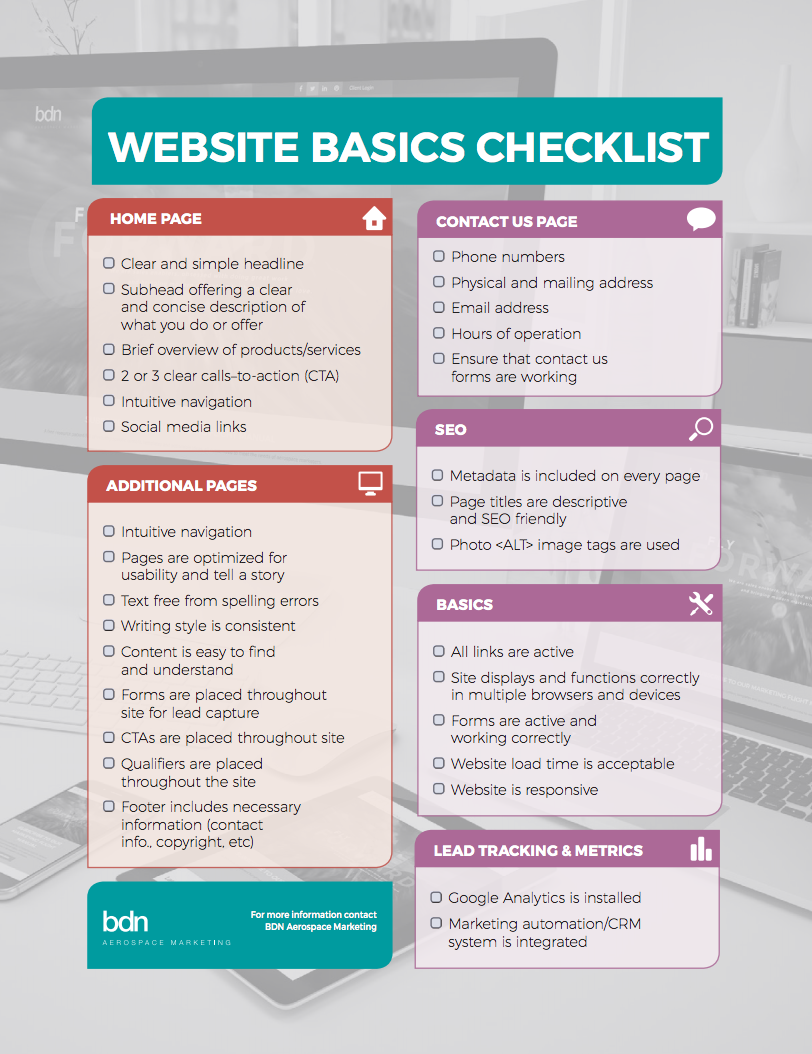
We’re capping off February’s month-long focus on websites with a checklist to guide you through the web development process.
Following these guidelines will ensure that your new website is built on a solid foundation. Or, use it to assess your current site and identify areas in need of improvement.
In addition to viewing the checklist below, you can download and save it for future reference.
SEO Basics for A&D Marketing
 Bad SEO. It happens more than you might think.
You just refreshed your aerospace company website, and it looks and sounds great. But no one is seeing it because you forgot about optimizing your website for search engines.
Sure, lots of customers are finding you through referrals and at trade shows, but more and more are looking for you online. In fact, 94 percent of business buyers do at least some type of online research, so search engine optimization (SEO) matters.
No need to feel overwhelmed or intimidated. Search engines, like Google, Yahoo, or Bing, use multiple factors to determine exactly where your website will rank in search results. And don’t worry — SEO isn’t as complicated as you might think. Use this basic primer as a start and you’ll be well on your way to increased organic website traffic from prospective buyers.
What is SEO?
SEO is a combination of efforts to improve organic (unpaid) search rankings.
It includes on-page (factors on your website) and off-page (factors off your website) ranking factors.
Some on-page ranking factors include things like the quality of your content, the inclusion of relevant words and phrases, descriptive meta titles and tags, quick load time, and URLs that include meaningful and relevant keywords.
Off-page ranking factors include the quality of the websites that are linking back to your site, social media links and mentions, and the overall reputation of your website across the Internet.
How do I create good SEO?
There is no shortcut to creating good SEO, but it seems like everyone is looking for a front-of-the-line pass for top-ranking positions. Our best advice? Just produce consistent, relevant and timely content to establish your business as a credible and trustworthy industry expert.
Where should I start?
SEO Must-Haves
- Quick site speed: Make sure that your load time is acceptable. There are plenty of online tools to help you determine your load time, even if you’re not a developer. Check out Moz’s toolbox here.
- Internal linking (linking from pages on your website to other pages on your website)
- Meta data (title tags, descriptions, and image alt tags)
- Mobile friendly
- Social media: Are you making posts on multiple social media platforms that will drive traffic back to your website? Pro tip: Don’t forget about Google owned Google+
- Links on other websites to yours (directories, blogs, etc.): Think about places beyond your website. Are there industry directories or blogs that you can be a part of?
SEO Must-Avoids
- Duplicate content: This might seem like an easy way to have more content or keywords on your website, but Google warns against it. Don’t fall into this trap.
- Hidden text: This is also a “black hat” tactic as Google would call it. It’s a shortcut that could very quickly have you blacklisted by Google
- Keyword stuffing: First and foremost, you need to make sure that your website is readable and user friendly. An overuse of keywords will make your website hard to understand for users
- Link buying: Guest blogging might be a great way to get quality links back to your website, but do not get in the habit of exchanging links and do not ever pay to have a link placed on a website
Want to learn more? Here are three resources for in-depth information:
Get Inspired: 5 Good A&D Websites
 We’ve written extensively about the importance of having a robust, user-friendly website. The website is where your buyers will start the process of connecting with you, it’s the front door to your business, and it’s the hub of your entire marketing program. No pressure, but you have to get it right — and it all starts with your homepage.
Hubspot put together a great article about what makes a good website and explains that the most brilliant homepages have all or most of these 7 qualities:
- Clearly answers “Who I am,” “What I do,” and/or “What you (the visitor) can do here”
- Resonates with the target audience
- Features a compelling value proposition
- Offers great navigation, usability, and mobility
- Includes calls-to-action (CTAs) to guide visitors to the next logical step
- Is always changing to reflect the needs, problems, and questions of its visitors
- Has a great overall look and feel
With these guidelines in mind, we thought it would be helpful to provide examples of aviation, aerospace and defense companies that are checking all the boxes for making a great first impression online. It’s not too surprising that there are only a couple of true B2B businesses represented in our top picks. The truth is that there is lots of room for improvement in this segment, with B2C enterprises generally being one very big step ahead.
Use these sites for ideas, inspiration and to gain a better understanding of what works. Here are BDN’s picks for the best of aerospace industry websites.
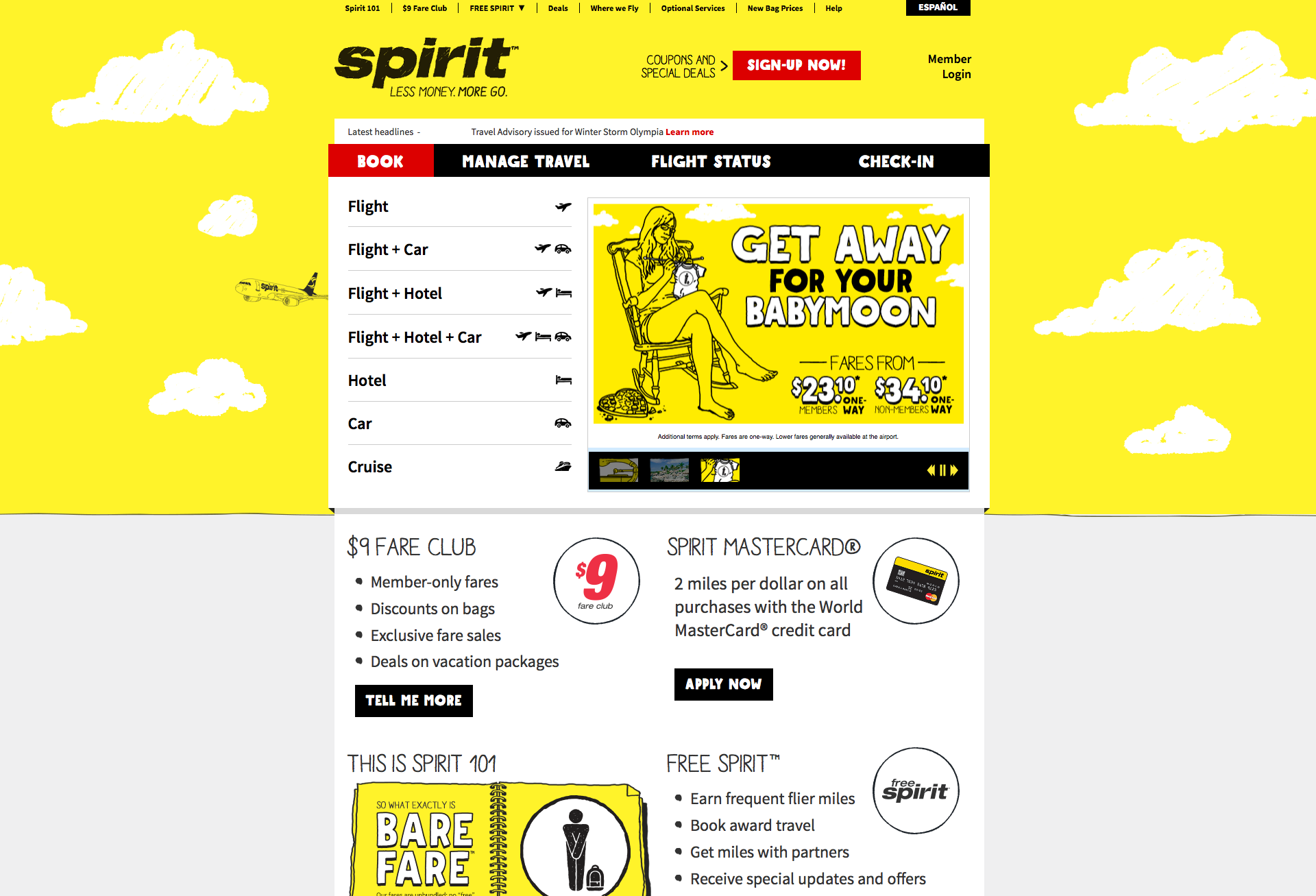
If you’re looking for inspiration, look no further than Spirit. Spirit’s marketing is top-notch across-the-board, so we expected nothing less online. Their clear and simple value proposition is front and center, and the site oozes personality and charm. The homepage provides clear tools that describe how Spirit works, and presents its pricing in a clear, easy-to-understand way. Unique colors, bold graphics, animation, and compelling calls-to-action pull everything together.
This site isn’t perfect or sexy, and it’s not breaking any new ground. But it’s doing a lot of things right, with a simple and direct value proposition, clear calls to action on the home page (Shop Fixed Wing, Shop Rotor Wing, Shop Engines/APU) and easy-to-find information about the aircraft and manufacturers Able supports. Need a part? Just use the simple search function. It’s a lot of information that could easily be overwhelming, but it’s not.
Clean, clever and classy, this site is completely in keeping with the Embraer brand and buyer. While we’d like to see gated content and more prominent calls to action, the aircraft comparison and range circle features are engaging and helpful, and the overall design is a breath of fresh air.
Like Spirit, the guys and gals at Gogo are masters of marketing, and their website reflects that understanding and expertise. Sure, it’s predictably aviation blue, but its uncluttered design and punchy messaging are atypical. Four oversized calls to action dominate the home page, and we love the way the navigation is built around buyers, and not the company or its products.
Quality imagery? Yes, please. Minimal but evocative copy? Love it. Stunning visuals take center stage here and underscore the importance of investing in the best possible photography. The eye candy invites the visitor to spend time exploring before taking a deeper dive for details about features, benefits and specifications. It’s an effective approach that’s unusual for our industry. The call to action is straightforward and easy to find – “Buy A5.” This website is proof that less is more, and we wish more industry sites would follow suit.
Bonus picks
At the risk of self-promoting, we think there’s a lot to learn from these BDN-developed sites, too:
Though there is a clear call to action, this website really isn’t about selling in the traditional sense. Instead it’s about storytelling, building credibility and generating excitement. BDN accomplished these goals with a fluid design where each page is one chapter in a larger story. Notably the site provides access to a media section. Hosting the latest news helps build credibility, and showcasing the impressive list of outlets that have featured the company enhances the brand. A regularly updated blog is part of the overall marketing strategy while also improving SEO and actively generating leads.
This site is all about giving buyers tools and information they need to drive preference and decisions while also serving as an important tool and force multiplier for the sales team. There’s a ton of downloadable content, including case studies, infographics and white papers, all with frequent calls to action. The straightforward navigation and modern design are refreshing, too. The strategically placed gated content and forms deliver hot leads to sales while providing valuable insight into the audience’s areas of interest. A portal for sales reps hosts an array of easily accessible tools.
It’s important that we practice what we preach, so BDN recently overhauled our own website to function with a clear goal of sales enablement. To learn more about how this lead generation effort is working for BDN, request a copy of our case study here
The 9 Things You Must Consider Before Redesigning Your Website
 We speak frequently with aviation, aerospace and defense marketers or business owners who call us to inquire about our web development capabilities. We love talking with them and learning about their challenges. Lately, we notice more people coming to us with concerns about the visual aspect of their sites, with many expressing a desire to update the site’s aesthetic appeal.
The Ugly Truth
We’re all for great-looking websites — they help us keep the lights on and they are essential to a healthy brand. But, frankly, a cosmetic update alone is like putting lipstick on a pig. It doesn’t change the fact that the website is fundamentally bad and not functioning as it should. It just makes the still-bad website look better.
It’s good to pay attention to your website. It’s an extension of your sales team and is arguably the most important part of any B2B marketing program, so it has to be right.
Back to Basics
When considering a website refresh, be sure you are focusing your time and energy on the right things. Here’s a list of 9 basics that are more important than visual appeal.
- Analytics: Do you have Google Analytics installed on your website now? If not, stop reading this and do it now. It’s free, and analytics reports provide invaluable information and intelligence you need to understand prior to making any changes. You’ll learn everything from what people are searching for on your site to identifying best- and worst-performing pages. Learn more at Kissmetrics.
- Update Content: Do you regularly update the content on your site? Or has the content remained stagnant since it was launched? A lack of updated information results in poor search engine optimization (SEO), which makes it unlikely that prospective customers will find you. Updates ideally should happen at least two or three times a week. If you aren’t prepared to keep all content relevant and fresh (blogging is ideal), a redesign will be a waste of time and money. Learn more here.
- Calls to Action: What do you want visitors to do when they visit your website? Having an answer to this simple question, and addressing it with multiple clear and compelling calls to action (CTA), is vital to even the most basic website. Kissmetrics provides five foolproof CTA formulas here.
- Keywords/Metadata/Page Titles: These are the critical underpinnings of your website that are essential to good SEO. You absolutely cannot afford to overlook this aspect of web development. The people at Moz provide a detailed tutorial on all aspects of SEO. To learn about the magic of keywords, metadata and page titles, read Chapter 4.
- Mobile-friendly: This one’s a no-brainer. It doesn’t matter how great your website looks, if it’s not optimized for mobile viewing, your work will be wasted. Sites that are not mobile friendly are harder to find on Google.
- Clean: It only took a couple of minutes to find these errors (see visuals) on aviation, aerospace and defense websites. Errors and typos happen to the best of us, but they raise questions about professionalism and attention to detail, so try to avoid them at all costs. Apostrophes are especially problematic. Refer to your AP Stylebook for details.
- Clear: This is an aerospace company with a fairly well known brand name. Can you tell what they do within just a few seconds of visiting their home page? “One Name. Many Solutions.” Hmm, that does not tell us much at all. Please don’t fall into this trap. Whatever you do, be sure to clearly state who you are, what you do and why visitors should care. Make it prominent. Make it clear. And make it matter. People will stay or leave your site based on this information.
- Usable: Take a step back and try to look at your website as a first-time visitor. Does it load quickly? Do all the links work? Is the presentation of information simple and focused or crowded and confusing? A usable website is one that intuitively and effortlessly guides visitors so they know how to find what they need. Able Aerospace has a good, meat and potatoes website clearly designed to satisfy the needs of its visitors. It’s not slick or sexy, but it gets the job done with a straightforward value proposition, easy navigation and frequent calls to action.
- Contact: Some people don’t want contact information posted on their website, because they don’t want to be bothered by phone calls. If this sounds like you, don’t bother having a website. Otherwise, make sure your web site includes complete, up-to-date, easy-to-find contact information. Thales Group is one example of a company that does not make it easy. We were unable to find any phone numbers, but did find a “contact us” page that required we select a topic, then a business domain, a geographical area, product type and activity domain, and then fill out a form with seven required fields. We wonder how many people use the system.
- Lastly, design: Once you can commit to all of the above you are ready for design. Aim for clean, modern and distinct — like this. It will set you apart from a sea of aviation, aerospace and defense websites that all look and sound alike. There are lots and lots of online resources for best practices in B2B web design. Or, be inspired by BDN’s own recently updated website.
Want more? We guarantee you’ll find this Content Marketing Institute article, “Why 55% of Potential B2B Buyers Might Not Trust Your Website Content,” to be especially helpful.
Sales Enablement: Expert Q&A
 So far this month we’ve talked about inbound marketing, 14 types of content to engage audiences, and lead generation. Each of these activities is part of the lead nurturing process that moves prospects through the funnel toward the ultimate goal of becoming a closed sale.
Of course, clients don’t always come to us with a request to enable sales — sometimes a discussion begins with ideas for possible solutions to a different perceived problem. But when we confer and dig deeper, the desire to increase sales and revenue is usually what is driving everything, and that makes sense. After all, the purpose of marketing is to enable sales.
In this installment of the Marketing Flight Manual, Lisa Sifuentes, BDN’s Vice President of Client Services and resident sales enablement expert, answers some commonly asked questions.
Why does BDN care about sales enablement? Is it a buzzword or here to stay?
We care about sales enablement because it aligns with our core beliefs that: the purpose of marketing is to enable sales; marketing can and should be accountable for results; and marketing efforts can and should be measured. It is not a buzzword or a flavor of the month — sales enablement is what modern marketers can and should be doing. More importantly, it’s what today’s clients need, want and expect — results, in the form of sales and revenue.
What is sales enablement? Can you give some examples?
Sales enablement is a proven business process that involves activities that sales and marketing teams perform to help sales operate more effectively. Aberdeen Research has shown that leading organizations applying sales enablement techniques are seeing results such as:
- 99% overall team attainment of sales quota
- 9% advantage in year-to-year revenue growth over average companies
- 4% year-over-year growth in average deal size
Just imagine delivering results like these in your organization. It would clearly position you as a business expert, enhancing your credibility and increasing your influence of the marketing function.
What are the challenges associated with sales enablement?
One common challenge is in overcoming the status quo and introducing new ideas and ways or working. Also, effective sales enablement depends on a closely aligned sales and marketing team. These two organizations can no longer act as adversaries but must come together behind a clear and common goal that neither can accomplish alone. Read more about breaking down the wall between sales and marketing at Media Bistro.
Finding the time and resources to measure and track results can also be challenging for aerospace, aviation and defense marketers, but measurement is essential to success. Learn more about measurement in Marketo’s Definitive Guide to Marketing Metrics and Analytics.
What marketing technique(s) might BDN use to help enable sales?
We’ve covered several techniques in this series, but specifically we employ email marketing, content, thought leadership and marketing automation.
Wrapping things up – Can you give our readers three tips to get started?
The most important thing is just getting started, and it’s OK to take baby steps and increase your capabilities for sales enablement over time. With that in mind, here are three things to start with today.
- Make sure your sales team can find and easily deploy content available to them. Simplify the delivery process and communicate.
- A Customer Relationship Management System – get one.
- Content calendar. Have sales and marketing brainstorm types of content that might be useful to your target audiences. You know more than you think and just need to put forward the effort to draft and distribute helpful information and resources.
P.S. Last week we promised more information about how to nurture and guide prospects through the funnel to a closed sale and satisfied customer. Silverpop has a comprehensive white paper, “From Cold to Hot: Lead-Nurturing Programs that Generate Sales” that covers this important topic very well.
Don’t forget: Digital marketing is key to most lead-generation efforts. Download this useful digital marketing guide to learn more.