
Author: Grace
Your First Steps Toward a Meaningful 2017 Marketing Plan
It’s time to start putting together your 2017 marketing plan. This is a big effort that will drive your work in the year ahead, encompassing strategy, messaging, tactics, execution, budget, and schedule.
It can all seem overwhelming, but it doesn’t have to be — if you follow our lead.
When BDN works with a new client we often start with a Discovery and Assessment session, and this is a good place for you to start, too. Following our detailed marketing planner, this structured information-gathering session includes a SWOT analysis, team interviews, discussion and brainstorming.
The intent is to gain an in-depth understanding of your business and sales process while establishing measurable goals and objectives for the marketing effort. It should result in a working diagnosis, preliminary ideas and an overall budget range, followed by a market pulse and in many cases, more detailed research.
In this week’s audio program, Lisa Sifuentes, Ashley Cutler and Nick Markwardt discuss the BDN discovery and assessment process, why it’s important, and how to make it work for you.
Play the session below or click here to download the MP3.
[vc_separator type=”” size=”” icon=”plane”]
Interested in this topic? You may also want to download the BDN Marketing Planner: http://bdnaerospace.com/marketingplan/
Lead-Gen for Aviation: How it Works
 Budgets are tight. Expectations are high. And marketing always seems to be on the hot seat to do more. We feel the pressure from management, from finance and, especially, from sales.
Finger-pointing between sales and marketing is nothing new. Salespeople say they don’t get enough support, tools or help from marketing. And marketing folks think sales lacks the discipline and follow-through to close.
It doesn’t have to be this way.
Marketers who embrace lead generation can shift these dynamics once and for all, fundamentally changing the relationship between sales and marketing, giving marketing more control over more of the process and making sales accountable for follow-through. At the same time, they can elevate their profile in the organization and move away from being on the defensive. There are three keys to making it happen:
- Shifting the marketing conversation from outputs to outcomes.
- Working with sales to jointly adopt and use a Customer Relationship Management (CRM) system.
- Implementing successful lead-generation campaigns.
Once marketing starts delivering measurable outcomes that link to sales, everything changes. And if you think lead generation won’t work in aerospace and defense, think again. BDN recently completed a sales and marketing campaign with a focus on lead generation for an avionics business, and the results were nothing short of astounding.
You can learn more in an all-new Success Insider case study, available for download now.
[vc_separator type=”” size=”” icon=”plane”]
If you like this blog you may also enjoy:
Audio: Lead Generation Case Study
This Marketing Flight Manual is downloadable audio content.
Is lead generation important to your business? This week, we sit down with Business Development Executive Ashley Cutler and VP of Client Services Lisa Sifuentes as they discuss their efforts on a recent lead generation campaign with host and Senior Designer Nick Markwardt. As you will hear, the results were nothing short of astounding.
Play this week’s session below or click here to download the MP3.
The full case study, including additional metrics and tips for improving your own lead generation efforts, will be available for download here on the Marketing Flight Manual next week.
[vc_separator type=”” size=”” icon=”plane”]
Lead Generation resources you might also be interested in:
How Questioning Everything Helps Aerospace Marketers Save Money
 Question everything. Marketers who work with tight budgets must get comfortable with questioning the status quo.
In 1987, the CEO of American Airlines saved $40,000 a year by removing a single olive from each customer’s salad. Thirty years later, budget-strapped aerospace marketers can learn how to save money from that legendary aviation industry CEO.
[vc_separator type=”” size=”” icon=”plane”]
Start by asking why.
Fast Company wrote about “The Importance of Creating a Culture of Why,” explaining that in many workplaces, “Why?” has become a stand-in for “I disagree.” When marketers fear creating conflict with co-workers, it can lead to “going along to get along,” which can result in bad spending decisions. Fast Company advises — and we agree — that we all need to reclaim “Why?” as a positive force in the workplace.
- Why should we place this ad?
- Why do we need to attend this event?
- Why are we printing so many brochures?
Tip: When you have clearly identified your target audience and have a complete understanding of your buyers and their behavior, it’s much easier to spend only on things that map to their needs and preferences. Build buyer personas as part of your marketing plan and bring this important information into focus. MarketingProfs created an excellent resource called “Beginners Guide to Creating Fleshed-Out Buyer Personas for B2B Inbound Marketing.”
Don’t get sidetracked.
Managing a tight budget requires focus that helps us avoid doing things for the wrong reasons (like to please a co-worker). Doing an ad, a show or printing brochures may be important, but asking the right questions can stop us from doing things for the wrong reasons.
- I don’t want conflict
- It’s a great deal/cheap
- Our competition is doing it
- We’ve always done it this way
Tip: Don’t spend your limited dollars on tactical experimentation, guesswork or assumptions — and don’t let anyone, even the most persuasive salesperson or colleague, convince you to do otherwise. Stay focused on goals and expected end results.
Keep asking questions, with a focus on outcomes.
If we are not tracking or evaluating results, and using what we learn to inform future spending decisions, we are shortchanging our employer and reinforcing the perception of marketing as a money pit.
- What exactly has this tactic accomplished for us in the past?
- How does this directly connect to our marketing strategy and goals?
- What is the expected outcome of doing or not doing this?
- How, specifically, will we measure success?
Tip: Successful aerospace marketers know that Customer Relationship Management (CRM) software is a critical data source that can help understand customer trends and behavior while showing marketers which tactics are driving leads and sales. DART Aerospace worked with ForgeCRM, a system designed specifically for manufacturers, and GE Aviation uses Salesforce.
Other budget-friendly resources:
Trade shows and events are important and expensive. Before you commit to anything, carefully consider and evaluate what you’ll get for your investment. This checklist can help.
A marketing plan can help you make focused spending decisions that link to the bottom line. Download a step-by-step template here.
How to Get the Aerospace Marketing Budget You Need
 New year. New opportunities. Same inadequate marketing budget.
Let’s face it, the budgeting process at too many aerospace and defense companies is flawed. Budgets may be dictated by people who don’t understand marketing…based on last year’s numbers instead of this year’s realities…or result from a last-minute fire drill because the boss wants numbers now.
Next year is going to be different. And it starts right here.
[vc_separator type=”” size=”” icon=”plane”]
Don’t Wait
Start mapping out your goals, strategy, plan and budget requirements now. Go to your boss well in advance of budget season with a buttoned-up, airtight business presentation that changes the conversation about the role, purpose and needs of a professional marketing organization. Elevate the discussion. Stop talking about outputs — you both should be focused on outcomes. Don’t spend time debating the merits of specific trade shows, advertising or other low-level tactics. They are simply a means to an end and should be left to the marketing team.
Actionable Idea: This marketing plan template is a good way to get started.
Have a Plan
Develop and present a plan that closely supports your organization’s business goals. Explain to your boss what you are recommending, and why, always linking back to expected outcomes. Show how marketing is a necessary investment — not a necessary evil — that is essential to business success.
Actionable Idea: Set the tone for an elevated discussion with an unexpected presentation format, like Prezi, or with a website or portal purpose-built and devoted to housing your proposed marketing program. Use the site to showcase your plan and offer it as a way for the boss to always have real-time digital access and visibility to marketing plans, activities and progress.
Use Data
In addition to a plan and business case, show the boss that your request is appropriate and supported by industry benchmarks. Brainrider reports that B2B marketing budgets as a percentage of total gross revenues remain steady at 2 percent, and other benchmarking sources show it’s closer to 5 percent. In our experience, aerospace businesses tend to spend less. Either way, the numbers need to be adjusted for new businesses, product launches, rebranding and other special circumstances.
Actionable Idea: Showing the boss that you are aware of best practices in budget allocation is also important, and referring to data bolsters your case.
Be Accountable
Establish and track three-to-five relevant Key Performance Indicators (KPIs) as agreed-on measures of success. Forget about vanity metrics. Impact Branding suggests five truly meaningful KPIs and explains how to calculate each one here.
Customer Lifetime Value – Understanding the value of a new customer can help you decide how much to spend on marketing.
Customer Acquisition Cost – Allocate your budget wisely by investing in the channels and tactics that have the lowest acquisition cost.
Sales Response Time – Customers are well on their way to making a decision before they ever contact you, so when they do reach out they are sales-ready. Don’t keep them waiting.
Inbound Links – Inbound links help SEO but also support brand awareness and authority.
Ratio of Website Leads to Marketing Qualified Leads – Too many unqualified leads waste precious resources but do little to drive results.
Actionable Idea: Post and maintain digital dashboards on your marketing website or portal.
Tell us about your budgeting process and how you get the resources you need. And, if you liked this post you may also enjoy our recent audio presentation. It provides actionable ideas for budget-friendly marketing.
Audio: Budget-Friendly Marketing
This week, BDN Aerospace Marketing is venturing into the world of downloadable audio content.
In this, our first audio installment, BDN founding partner Kyle Davis and VP of Client Services Lisa Sifuentes share some of their favorite ideas for getting the most out of a tight marketing budget. Senior Designer Nick Markwardt guides the discussion as we touch on topics ranging from developing an annual plan and leveraging digital tools, to identifying and challenging budget-sapping “sacred cows.” In just 15 content-filled minutes, we reveal that good marketing doesn’t have to be expensive marketing.
Play this week’s session below or click here to download the MP3.
Resources mentioned in the show:
Blueprint for Branding
BDN fields a lot of questions about branding, and that’s what inspired this month’s series. If you’ve already determined that you have a branding problem, this blog is for you. Here we outline a process for branding and walk you through what’s required to create or revamp your aerospace business brand strategy.
- Identify and Understand
You’ll need to conduct research in three key focus areas to gather the insights, data and intelligence that will inform your brand strategy.
Focus: Industry and Markets
- Identify relevant trends and opportunities in the industry – it will help ensure that your branding choices are in line with market realities
- Scope your market by size and segments
Tip: To keep your branding project on track, make sure you understand both company goals and sales goals, and how the brand will support them.
Focus: Customers
- Identify existing and potential targets
- Assess levels of awareness of you and your competition
- Understand perceptions of you and your competition
- Find out what customers need and value
- Uncover their pain points
Tip: Ask questions about the decision-making and buying process. Where do your customers get information? How do they research products? What factors most influence their buying decisions?
Focus: Competition
- Identify key competitors
- Determine relative market share
- Define their products and services as they relate to yours
- Assess their brand identity and messaging
Tip: Does everyone’s messaging sound the same? Do visual identities seem similar? This is a great opportunity to look and sound different.
Once all information has been gathered, analyze and synthesize what you have learned and refer to it in making these upcoming critical brand decisions.
- Develop Brand Strategy
Your brand strategy helps establish your company’s best possible position in the market. Think of it as your aerospace and defense sweet spot.
Focus: Positioning
- Above all else, what one thing do you want to be known for?
Tip: Resist the temptation to try and be everything to everyone. It dilutes the brand you are working so hard to create.
Focus: Differentiation
- What one thing really makes you different? How do you add and deliver value to your customers?
Tip: This needs to be more than lip service about “quality” or “passion.” Everyone has those messages. This statement needs to capture the essence of what make you different than every other provider.
Now you begin the process of creatively translating everything you’ve learned so far. All-too-often this is where branding initiatives begin and end. But shortchanging initial steps in the process will leave you with a brand that lacks substance and meaning.
- Define the Brand
Making sure that your definition aligns with your prospects’ needs, preferences and pain points, detail how you want to be perceived and how you want people to feel, think and talk about you.
Focus: Architecture
- Are you a house of brands? A branded house? Or something else? What are the elements of your brand and how do they all work together?
Tip: Keep your structure simple and memorable. Too many companies create brand confusion by naming and designing logos for everything under the sun.
Focus: Personality
- What is your voice and overall sensibility? Is it highly technical? Or is it something more human? Lofty and formal? Or down to earth and approachable?
Tip: You can’t fake this. Whatever you decide to be; be authentic.
Focus: Messaging
- This encompasses your story, value proposition, key supporting messages and a tagline, if appropriate.
Tip: Make it fresh and memorable. Don’t settle for something that is boring and predictable or full of buzzwords. Need help? Download BDN’s Guide to Crushing Your Competition with the Perfect Value Proposition.
Focus: Visual Identity
- From your logo and color palette to your fonts and photos, what does your brand look like?
Tip: Start with a mood board and get incremental buy-in from a few key stakeholders. Always move the discussion away from subjective opinions, have a solid rationale to back your recommendations and stay focused on the real audience.
Focus: Culture
This is all about your company’s core values and how you live and breathe the brand internally.
- How will the brand manifest within your company? What are expectations for employee performance and behavior?
Tip: It’s essential that the CEO believes in, embodies and champions the brand. Your branding project cannot succeed without this executive-level buy-in.
Thanks for reading! If you liked this blog, these other resources about B2B branding may also be of interest.
Bop Design developed a Quick Reference Guide for B2B Branding that includes helpful definitions, dos and don’ts, and more.
This Strategic Marketing Roadmap for small- to medium-size businesses emphasizes the branding process. Shout out to Marketing Mo for this in-depth resource.
Looking for expert assistance? Download BDN’s Guide to Selecting a Professional Marketing Firm.
Realize the Full Value of Your Aerospace Business Brand

Taking on a branding or rebranding program for your aerospace business is not for the faint of heart. Brand work requires discipline, focus, commitment and, above all, honesty.
In our last edition of the Flight Manual we listed 10 warning signs that you might have a weak brand. This week, courtesy of Lippincott, we are providing a list of questions to jump start the branding discussion internally.
If you think you have a branding problem and want to take steps to address it internally, we suggest starting with a very small team of strategically minded leaders who are willing to take an unflinching look at your business and answer these questions. There is no room for ego or living in the past, and this is not a job for a large committee.
This more detailed assessment will not be easy, but it is a necessary step in further assessing the health of your brand and getting internal alignment on how or if to proceed, which is critical.
Are you faced with skeptics who argue that branding is not important to aerospace and defense businesses? This data from the Harvard Business Review speaks for itself.
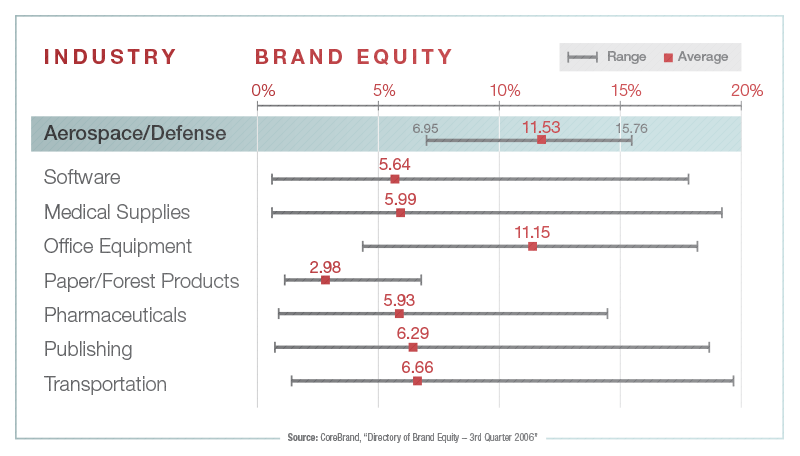
Bear in mind that these questions are just a starting point. Audience research is advisable to validate your internal assumptions and get a true picture of how you are perceived.
- Does our reputation immediately put us on our customers’ mental short lists for their next big orders or programs? How do we know one way or another? If we don’t know, how do we plan to find out?
- Are we on our customers’ preferred supplier lists? If so, where do we place, and how does that compare to our place last year or two years ago? If we’re not on the list, why is that and what do we expect to do about it?
- Does our brand help us to hire world-class talent? What does our brand stand for with potential recruits? Do we even know? For that matter, what do our employees think about our brand — or about any of our product brands? Are they proud of the name—or ashamed of it? Do they encourage or discourage others to join the company?
- Could our brand help us win a bid if reputation were the deciding factor? If not, why not? Why might our competitor’s brand help them win instead?
- What does our brand say about us to potential new customers? Does our brand give us entrée to expand into adjacent markets? To take on higher value-added roles such as consulting services? Or are we forever painted as one particular kind of company, unable to do anything different?
- To what extent is our brand being eclipsed as our big customers or channel partners consolidate and become better-known to end customers and Wall Street?
- What do we need to do to keep our brand from disappearing?
- Do investors really know us? How does Wall Street describe us? How does that square with how we see ourselves?
- Do we have the right mix of brands to go to market? Do our brands fit together logically? Are we supporting and spending on the right brands?
- How smart are we about our own brand? What should our brand stand for? Can we describe our brand strategy in a 20-second elevator pitch? What’s different about it? What does it contribute to the bottom line? Which customer touchpoints make the biggest difference to our brand?
- Are we actually living the brand? Do our employees know how to deliver our brand? Do they have the tools to do so?
Source: Lippincott originally published these 10 “Call to Action” questions in an excellent resource called “The Rise and Rise of the B2B Brand.”
Up Next
Moving Ahead: Your Blueprint for Branding
Also
If you liked this blog you may also want to read about the “5 Branding Myths that are Hurting Your Aerospace Business.”
Does Your Aerospace Business Have a Branding Problem?
 We hear from lots of aerospace and defense professionals who think they have a branding problem or who tell us they want to “take their brand to the next level.”
Quite often they are thinking about their brand in visual terms, and it’s true that design is a critical element of any great brand. But there’s so much more to consider when evaluating the strength of your brand.
Now, as we continue our month-long series about aerospace industry branding, it’s time to take stock.
Before we launch into detailed recommendations about repairing or rebuilding your brand, let’s consider if you do in fact have a brand problem.
Start by taking this quick 10-question assessment as a first step in the process. Each “yes” answer is a red flag; and multiple yeses are a strong indication that your brand is in trouble and further action is required.
10 Red Flags
Weak brands share many or all of these characteristics.
- Do you consistently compete on price?
- Does your business lack a clear focus and do you try to be everything to everyone?
- Are you unable to articulate a true value proposition — something customers care about that distinguishes you from everyone else?
- Does your brand architecture create confusion? Confusing brands have too many individual product names or sub-brands, and multiple logos, taglines and messages.
- Does your CEO fail to actively support or champion branding?
- No single person owns the brand internally, standards don’t exist or are not followed.
- Is your market, your business or your business strategy undergoing significant change?
- Does your company suffer from the “me too” syndrome, where nothing looks or sounds unique? And does your leadership wants you to fit in and fall in line with what others are doing and saying?
- Are you in a crowded market space and not growing?
- Is your messaging company-centric and not customer-centric?
If you’d like to dig deeper and start seriously assessing your brand, this Lippincott resource is a great place to start.
Want to see a ranking of the 25 most valuable brands in aerospace? A few of them just might surprise you.
Up Next: Find out how to build or rebuild your aerospace industry brand. We’ll walk you through the process one step at a time.
5 Branding Myths that are Hurting Your Aerospace Business

Branding is an ongoing source of discussion and disagreement in aerospace marketing, according to our recent industry surveys.
While some say they spend a lot of time and effort building their brand, far too many say that investing in branding is a waste of time and money.
As we enter into a month-long examination of aerospace industry branding, we start by tackling these 5 myths that are holding us back from better branding, better marketing and better results.
Myth No. 1: Branding is a waste of money.
Really? Consider this.
Valued at $121.8 billion, Microsoft’s B2B brand is the most valuable in the world. Siemens, a company with strong interests in aerospace, ranks at No. 20 with a value of $12.4 billion. Read more here.
But there’s more. A McKinsey study of B2B brands shows that companies with brands that are perceived as strong generate a higher EBIT margin than others.
In fact, strong brands outperform weak brands by 20 percent. A Forbes article, “Why B-To-B Branding Matters More than You Think,” cited the example of pump manufacturer Gardner Denver, reporting that the company attributes 43 percent of its value to be goodwill and other intangible assets.
This is consistent with our experience and our research. In one engagement, our client research showed that although two direct competitors had virtually identical ratings for factors like product quality and reliability, respondents were twice as likely to buy from the one with a large, well established brand name. When all other factors were equal, the best brand won.
Myth No. 2: Branding is only for consumer companies and has no bearing on a customer’s decision-making process. People will buy from us if we provide good products and competitive prices.
We hear this a lot. But the Forbes article reports that B2B brands are actually more important than B2C brands because B2B purchases matter more. “Buy the wrong toothpaste, and you can always change brands when the tube runs out. Buy the wrong turbine and you could hurt your company’s earnings for years – and find yourself looking for another job.”
Trust is paramount in our industry, and is a critical factor in any B2B buying decision. But you can’t sell trust by telling people you are trustworthy in an ad or a brochure. They have to feel it — and that happens through a clear and consistent brand experience.
Myth No. 3: My brand is my logo and tagline.
Your logo (and tagline if you have one) is an incredibly important part of your brand, but it’s only one element. Logos serve as a kind of visual shorthand for your business to help customers immediately identify and recall who you are and what you do.
Branding is also not synonymous with marketing. Marketing certainly contributes to a brand, but like the logo example, it is one small part of a much larger whole.
Writing for the Tronvig Group, James Heaton defines branding as “the expression of the essential truth or value of an organization, product, or service. It is communication of characteristics, values, and attributes that clarify what this particular brand is and is not.”
Heaton nails it, especially when he says this. “A brand will help encourage someone to buy a product, and it directly supports whatever sales or marketing activities are in play, but the brand does not explicitly say, “buy me.” Instead, it says, “This is what I am. This is why I exist. If you agree, if you like me, you can buy me, support me, and recommend me to your friends.”
As we tell our clients, a solid brand and strategic marketing program won’t make the sale, but they will create an environment conducive to making the sale.
Myth No. 4: Branding is for big companies with big budgets.
Once upon a time this may have been true. Building an aerospace brand has traditionally relied largely, but not exclusively, on advertising.
But advertising is expensive and it can be challenging to show a return on the investment made. For those who aren’t in a position to advertise, social media is a great and affordable tool for defining and building your brand, all while interacting with your audience and giving them a feel for who you are.
At a time when many aerospace businesses look and sound alike, small companies, especially, can leverage branding to set themselves apart from competitors, get noticed and be remembered!
For more ideas and inspiration, see how several B2B businesses, including GE and Maersk Line, are successfully using social media to build their brands.
Myth No. 5: Brands appeal to emotional buyers. B2B buyers make rational decisions.
B2B buyers are people. And people have emotions. Marketo makes the case that because B2B buyers are overwhelmed by information they use heuristics (a simple and efficient emotional shorthand used in decision-making). In fact, “whether or not the buyer realizes it, the decision is often made long before the buying process is completed. When this happens, even subconsciously, much of the buying process ends up being an effort to justify the initial emotional decision. B2B marketers can and should tap into this by appealing to the emotional side of their prospects, as well as their rational side. This is where branding comes in.”
Does your business believe in branding? Do they invest in it? Why or why not?
If you like this article, you may also be interested in: